October 09, 2017

The Other Girl - Erica Spindler


St. Martin’s Press, August 22, 2017.


Four Stars


When she was fifteen, Randi Rader was kidnapped by a stranger who picked her up hitchhiking – she escaped before too much damage was done, but she was forced to leave another girl behind with the kidnapper. When she went to the police for help, however, no one believed her story. Randi had a troubled family life and several run-ins with the law, and she still carries the guilt that because of her past, she will never know what happened to the other girl that night.


Now an adult, Officer Miranda Rader works for the police department in a neighbouring town in Louisiana. Despite her negative experience with the police in the past, Miranda has vowed to use her sense of honesty and integrity to protect innocent victims like she once was. Her current chief of police was the only officer that believed her that night, and she trusts him completely. So when he calls her to a crime scene in the middle of the night, Miranda follows unquestioningly.


The crime scene turns out to be the ritualistic murder of a well-liked local college professor with strong family ties to the community. Because of the way he was found, Miranda immediately realizes that the killer was intimate with the victim. She searches the house for clues, but doesn’t find anything leading to the killer – instead, she finds a newspaper clipping about her own childhood kidnapping. When Miranda’s fingerprints are later found at the scene, she realizes that someone is trying to frame her for the murder – but she has no idea how she’s connected to the victim.


Miranda soon becomes the prime suspect of another murder – the death of the police chief who failed to believe her kidnapping story on that night. Her current chief and friend is forced to suspend her from duty, although his motives are becoming unclear – is he protecting Miranda, or himself? Meanwhile, Miranda begins a romantic relationship with her partner Jake, who seems to support her innocence, although there is no one she can completely trust. Even her best friend becomes a suspect, and Miranda must question the motivations of everyone around her.


This is a thriller, filled with twisty suspense and edgy excitement. While the characters could have more depth, they are surprising in many ways and often slip out of their stereotypical roles. It wasn’t difficult to guess what was coming at the end, but it was still a completely entertaining read. Miranda is able to trust her own instincts in order to survive the final showdown with the killer, and with her own past. While this is a typical thriller in many ways, the interesting characters and their individual choices made this a satisfying summer read.


I received this book from St. Martin’s Press and NetGalley in exchange for an honest review.

October 01, 2017

The Atlas of Forgotten Places - Jenny D. Williams

Thomas Dunne Books, July 11, 2017.


Five Stars


The Atlas of Forgotten Places is a surprising, incredible novel that really has it all – a thrilling, adventurous narrative, strong and powerful characters, and a plot entwining historical, political and current events. Most of all, it is an exploration of family, friendship, and the lengths we will go to protect our loved ones –  and how that love unites us across borders.


The novel is narrated by two very different women, brought together in their search for the people they love – especially when they learn that those two people may have gone missing together. Sabine Hardt was an aid worker in Africa for many years, until a tragic event made her doubt her ability to make a difference in the world. She retreated to a quiet life in her native Germany, watching from a distance as her American niece Lily takes her place in Uganda. Envisioning a future of helping people, Lily is wide-eyed and optimistic in her emails to her aunt – until she suddenly disappears on her way home to America. Sabine makes the inevitable trip to Uganda to search for Lily, bringing back surprising memories of her past.


While tracking Lily’s movements, Sabine meets Rose Akulu, a young Ugandan woman working with the American aid workers, offering support to the victims of Joseph Kony’s Lord’s Resistance Army. Rose herself was kidnapped by the LRA as a child – she eventually escaped, under circumstances that are slowly revealed, and returned to her village with haunting memories and a missing arm. Members of the LRA who return home are shunned by their former friends and family, and Rose was only able to find solace in her boyfriend Ocen, whose brother was also taken by the LRA. Now Ocen has disappeared too, and the evidence suggests that he may be with Lily.


Sabine and Rose do not completely trust each other, but with the help of relief worker and mutual friend Christoph, the two women are willing to sacrifice everything to find Lily and Ocen. As an American girl, Lily’s disappearance is publicized by the western media – meanwhile, Rose worries that Ocen will be collateral damage in the search for Lily. Williams does an impressive job of creating complicated, emotionally-charged characters who realistically reflect the situation in Uganda – white aid workers are attempting to do good, helping people during a time of civil war, but their role in Africa becomes an echo of the colonialism that caused these issues in the first place.


Williams has obviously spent time in Uganda, and the setting comes alive in a real and assured way. The novel is written in clean, straightforward prose that clearly reflects the complex political situation in Uganda – there is no awkwardly inserted exposition about the war, but instead it is explained as it is relevant to the scenes and characters. There are also no simple explanations of good vs. evil here – when children are kidnapped and forced to kill, and then ostracized by their families when they return, we are forced to witness the true extent of human cruelty. And there is no escape into fiction, as this novel is based on real-world, current events that we cannot look away from.


Sabine and Rose each have distinct voices and perspectives on the situation around them – neither one is particularly likeable, and yet as their backstories are revealed, both are sympathetic and real. Although these women come from extremely different circumstances, they are more similar than they realize. And while the ending of the novel is sudden and unresolved, it is certainly hopeful – it leaves room for many possible outcomes, including the hope for a future in which we can be united across borders to prevent child soldiers and the men who create them. Most of all, there is hope for people like Rose, whose childhood was taken from her, and yet she emerged from the jungle willing to help others discover a better way of life.


I received this book from Thomas Dunne Books and NetGalley in exchange for an honest review.

September 24, 2017

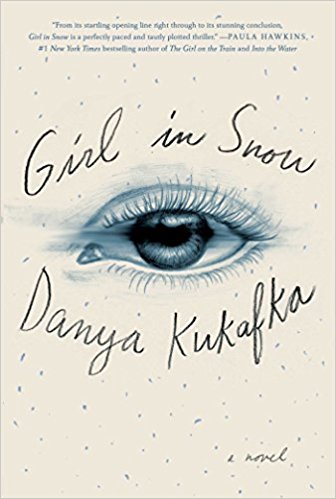
Girl in Snow - Danya Kukafka


Simon & Schuster, August 1, 2017.


 Four Stars


On a frozen, snow-covered morning, the body of popular high school student Lucinda Hayes is found in a local park. In the small Colorado neighbourhood, everyone knew Lucinda – and everyone is affected by her death, whether they liked her or not.


Girl in Snow is narrated by three characters with connections to Lucinda. Cameron is an anxious, unpopular boy who was obsessed with Lucinda – he drew detailed portraits of her and watched her through her bedroom window at night. Jade is an edgy girl with an alternative style, whose alcoholic mom and miserable home life make her jealous of Lucinda’s seemingly perfect world – she also admittedly hated Lucinda for stealing her babysitting job. Finally, Russ is the officer in charge of investigating Lucinda’s murder, and he also has a strong connection to the family of his main suspect, Cameron.


Each character works to expose the others’ secrets while confronting their own emotions as they all search for the truth about Lucinda’s death. The novel explores how people can see us and interpret our lives in different ways, while never knowing the truth about who we are – not just Lucinda, but all of the characters are judged by who they appear to be. Cameron expresses himself through his artwork, while Jade’s sections often shift into her dramatic screenplay in which she envisions the scenes that she wishes had taken place, and the conversations that sounded better in her mind.


Lucinda could have been killed by anyone in her small suburb, but as more backstory is revealed through the eyes of different narrators, the identity of the murderer becomes inevitable. This novel is ostensibly a mystery-thriller, but the focus is ultimately on character development. The only exception is Lucinda, who remains fairly flat, but she acts as a device to bring everyone else together. The story is written in clear, concise prose, yet it is saturated with depth and emotion – Kukafka’s words are evocative without being overly descriptive. As the characters become increasingly intertwined, they show the unknown connections between all of us – and how appearances can be deceiving.


I received this book from Simon & Schuster and NetGalley in exchange for an honest review.
September 20, 2017

The Only Cafe - Linden MacIntyre


Random House Canada, August 8, 2017.


Four Stars


Cyril Cormier grew up in Toronto with a Lebanese refugee father and a mother from Cape Breton. They divorced when Cyril was young, and he didn’t see much of his father Pierre, who was a successful corporate lawyer with a new, younger wife and infant son. During an international scandal at the mining company where he worked, Pierre went missing under suspicious circumstances – there was an explosion on the boat he was living on, and his body was never found.


Five years after Pierre disappeared, one of his bones is found and he is finally declared dead. When the will is read, Cyril and the rest of the family discover that Pierre included an unusual request – instead of a traditional funeral, he asked for a “roast” to take place at a bar in Toronto’s east end called The Only Café. There is also a mysterious name on the guest list, “Ari”, that none of the family had ever heard Pierre mention.


At the time his father is declared dead, Cyril is interning at a national newsroom (likely modelled after the CBC) that is working on a documentary about homegrown terrorism. When Cyril’s Lebanese background is discovered by his bosses, they ask him to bring a personal perspective to the war on terror. Cyril decides to investigate the events that led to his father’s death, and the first step is meeting with the mysterious Ari. Cyril discovers that Ari was an Israeli soldier who met Pierre in Lebanon in the 1980s, during the Lebanese civil war.


Cyril suspects that Ari can answer questions not only about Pierre’s past but also about whether his father is truly dead. Soon Cyril’s personal investigation intersects with the larger story of terrorism at the newsroom, and there are surprising connections to his friends and colleagues. The deception stretches from the present day back to the Lebanese massacres of September 1982, and the plot is grounded in these historical events, bringing the current political climate in the Middle East into sharp focus.


The Only Café is a slow-paced mystery with both historical and contemporary relevance. It demonstrates how history is constantly repeating – with different forms of terrorism always in the background and bubbling up to the surface over time – and it puts a personal spin on the stories we often hear from a distance. There is plenty of dialogue to keep the story moving forward, although there perhaps could have been more inner contemplation and character development. There are constantly shifting perspectives, which were sometimes confusing and overly complex – there are only so many health, family and work dramas that one person can go through, and they really didn’t add that much to the story. But despite my issues with the novel, the writing was powerful enough to continually draw me back in to this complex and timely story of family secrets and their effects on global events.


I received this book from Random House Canada and NetGalley in exchange for an honest review.

September 17, 2017

Emma in the Night - Wendy Walker

St. Martin’s Press, August 8, 2017.


Five Stars


Emma in the Night is Walker’s second novel after 2016’s All is Not Forgotten, and while the two books share much in style and substance, I found this one more compelling and enjoyable. Three years ago, the Tanner sisters – 17-year-old Emma and 15-year-old Cassandra – went missing with no explanation. The circumstances were suspicious – Emma’s car was found abandoned in a parking lot near the beach, and her shoes abandoned by the shore. There was no evidence that Cass was with her, and yet she is gone too.


Now, three years later, Cass shows up on her mother’s doorstep – without Emma. She tells an incredible tale about kidnapping and captivity on an isolated island which cannot be located, and a daring and dangerous plan for escape. Forensic psychiatrist Abigail Winter worked on the Tanner sisters’ case years before, and she always felt that there was some obvious clue that she was missing. Now, hearing Cass’s story and watching her interactions with her mother, she suspects that the reason for the girls’ disappearance is close to home. With Cass’s help, Abby slowly uncovers the dysfunctional family’s secrets of narcissism and abuse.


The novel is told in dialogue, as Cass slowly reveals her (perhaps unreliable) story in careful moderation – she manipulates her audience much as Walker leads the reader on this fascinating journey. The structure of this novel is much like Walker’s first novel – it is an unconventional thriller in which the story takes place after the main action has concluded. It is more like reading the case notes of a crime, delving into the obsession and mental illness that formed these characters. There is much more telling than showing, and yet it works. Cass’s story is perhaps even more compelling because we did not witness the action and therefore cannot know if anything she’s saying is true.


The procedural aspects of the story are not all that realistic, but it is worthwhile to suspend disbelief and trust that each piece will eventually fit together. The slow reveal is geared towards reader manipulation – to keep us guessing and successfully create suspense. I thought some of the characters could have been more complex, instead of so clearly good or evil – but Cass especially was intriguing. Her narration is detached and cold, which keeps the reader at a distance, but it works because she withholds her true feelings and motivations right up to the last scene.


While Emma in the Night has its flaws, Walker is a talented storyteller who manages to lead the reader without oversimplifying the story. The descriptions of mental illness are fascinating and disturbing, especially as Emma and Cass are affected by their mother’s behaviour in very different ways. Cass’s flat narration has a strong emotional undercurrent that gives depth to the novel, creating an intelligent and thoughtful mystery that crosses genres in unexpected ways.


I received this book from St. Martin’s Press and NetGalley in exchange for an honest review.