November 14, 2015

Bright Stars - Sophie Duffy


Legend Press, October 1, 2015.


Three Stars


The synopsis of this book tells us that four students are involved in a tragedy that rips their friendship apart, and they are reunited twenty five years later. I found this a bit misleading, because the “tragic event” really played such a small part in the story. There wasn’t even much anticipation leading up to it, and in fact I forgot that we were waiting for some sort of climax to occur.

Complicating things further was the fact that there were actually two incidents we were supposed to be looking forward to – one in 1988 when the four were students, and another in 2013, in which Cameron lost his marriage and may be losing his job. Because there were not many clues to either incident, they just didn’t seem that exciting and it was sort of a let-down when we discovered what actually happened.

With two incidents set in different time periods, there was a lot of jumping back and forth between the timelines. It was very choppy, and the time changes happened randomly, with no flow. It also didn’t help that there were multiple footnotes at the end of each chapter that explained small details and didn’t really add anything to the story – they were mostly just Cameron trying to be clever.

While the insecure Cameron is uncertain how he fits into the group, he is in fact the one holding it all together. I did like the four oddball main characters, who were all very flawed and yet likeable. Aside from Cameron, there is also Bex, a politically minded beauty who Cameron is quietly in love with. Tommo, Bex’s boyfriend, is the classic bad boy, playing in a band and getting into trouble. Then there’s Christie, on exchange in England from Canada, so of course she gets along with everyone. There were some clever lines and astute character-building. Their actions show the fine line between good and evil, as the four young people grow into mature adults and learn to take responsibility for their actions.

The title of the novel is from one of Tommo’s band’s songs, taken from a John Keats’ poem. It was who they were, until one tragic event dimmed the light of their friendship. The storyline is original and unusual, and doesn’t fall easily into any one genre – part mystery, part romance, part coming-of-age story. The pace accelerated towards the final reveal, but in the end, it was anticlimactic because it didn’t really matter at all. The ending was somewhat happy, but tied everything up a little too neatly. There were some bright moments in this novel, but I was left wishing for more.

I received this book for free from Legend Press and NetGalley in exchange for an honest review.

November 11, 2015

The Determined Heart - Antoinette May


Lake Union Publishing, September 29, 2015.


Four Stars


The Determined Heart is the story of Mary Shelley, best known as daughter to philosopher William Godwin and feminist Mary Wollstonecraft, and wife to poet Percy Bysshe Shelley. In this novel, Mary Shelley is finally given her own spotlight, as the author highlights Mary’s own literary achievements amidst the many struggles she faced.

Mary’s melodramatic childhood would be unbelievable if it wasn’t based on fact: her mother died shortly after her birth, soon to be replaced by an evil stepmother and demanding stepsister. Her father was moody and unreliable, constantly using his friends to pay his debts, and her older sister Fanny was virtually ignored, eventually choosing suicide over spinsterhood. The drama carries forward into her adult life, when she runs away with a married man who will ultimately be unfaithful to her as well. Her love story with Bysshe, as she called him, was complicated by his ideals of free love, much of which involved him sleeping with Mary’s stepsister, Claire. Meanwhile, Claire was carrying on a relationship with – and eventually carrying the child of – the infamous Lord Byron, which resulted in yet more scandal.

All of these multi-layered plot points would have been way too much if they hadn’t actually happened – and this novel is very well-researched, rich with historical details. My only complaint is that some of these issues were skipped over without a lot of emotional content. I especially wished for more depth to the love story between Mary and Bysshe – it happened so suddenly, and there was a lot of telling us how they felt, instead of showing how their love progressed.

I didn’t find either of the main characters to be sympathetic, until Mary began to focus more on her creative life. Living in the shadow of the literary Shelley, Mary epitomizes her mother’s famous work: A Vindication of the Rights of Women. It was interesting to see the moments in Mary’s life that inspired her to write her most famous work, Frankenstein. She had a great interest in the advances of science at the time, including the new “electric machines.” The story of a man resurrected from the dead had more meaning to Mary as she lost several of her children and wished for nothing more than to bring them back. She dreamed of finding a means to “not only create life but sustain it.” (loc. 3913) Finally, Lord Byron’s challenge to his friends on a dark and stormy night to write a ghost story led to Mary writing her novel, which has now surpassed even her husband’s literary achievements.

The circumstances in which Mary and Bysshe lived would be shocking even today – a married man living with two sisters, he was ostracized from his contemporaries, along with Mary. Posthumously, Mary realizes that Bysshe was a “cad” who cared about himself above all; however, she was able to objectively view the genius of his work, preserving it as a legacy for their son. After Bysshe’s death, Mary was “free to be her own creation” (loc. 5963) and pursue her own dreams.

In this novel, the author brings factual events vividly to life – it is perhaps the resurrection that Mary dreamed of. The characters are very well-formed, with men we think of as brilliant literary giants (Godwin, Byron, Shelley) shown with all their human flaws. The Determined Heart focuses on Mary’s years conceiving Frankenstein, but in the process she created a life for herself as well, and her determination would have made her feminist mother proud.

I received this book for free from Lake Union Publishing and NetGalley in exchange for an honest review.

November 09, 2015

Lost in Geeklandia - E. J. Russell


Entangled Publishing, September 28, 2015.


Two Stars


The vivid cover and clever description drew me into requesting this book, but the contents just didn’t measure up for me. It is a story about computer engineer Charlie, who has coded an algorithm for love. Her own program tells her that Daniel, her former friend turned enemy, is the one for her. Meanwhile, Daniel is highly suspicious of dating, but Charlie seems irresistible.


It seems like it should be a cute, geeky love story, but the geeky part overshadowed the rest. The plot is constantly interrupted with techno-jargon and geekery – some of it is fun, but a lot is just annoying. I found the story hard to get into; overall it was convoluted and gimmicky. The premise starts out sweet but becomes too cutesy, and everything is resolved too easily. For instance, Charlie thinks that Daniel hurt her in the past, but he doesn’t even realize he’s her nemesis – then suddenly, everything is fine between them.


Maybe I was expecting too much, for a story like this to be more complex than it is. If you like your romance simple and sweet, then this story is fine, I just prefer a few more surprises and less of a formula. I also felt like the geekiness was trying too hard. The characters had their funny moments, but I just found it hard to believe the connection between the main characters. Still a fun story.


I received this novel from Netgalley and Entangled Publishing in exchange for an honest review.

November 06, 2015

The Two Levels - Jonathan Miller


June 18, 2015.


Three Stars


It is always an ambitious choice to write a novel from a child’s point of view. In this case, parts were very successful, while others did not work. Seven year old Jasmine continually fluctuated from childlike innocence to an adult understanding of the world around her – some of this knowledge could come from the serious situation she finds herself in, but the inconsistencies took me out of the story and made Jasmine less believable.


Jasmine and her parents are returning from a trip to South Africa, in which they make an unexpected layover in Sierra Leone. Upon their return to the United States, chaos breaks out in the airport because some of the African passengers are showing signs of illness – a topical reference to the Ebola crisis. Jasmin and her African-American mother get caught up in the ensuing madness, and end up locked in the upper level of a shopping mall with the African passengers. Meanwhile, downstairs, a predominately white mall workers retreat (is this a thing?) is taking place. Jasmine, being biracial, is caught in the middle, venturing downstairs to find medical aid for her mother. Neither group truly accepts her, although they both use her to get what they want from the outside authorities.


The novel is an interesting, albeit obvious, examination of race issues, mainly illustrated by Jasmine’s being ostracized from both levels. She begins to question her own identity, as she is shut out from the African community for being too white, and kicked out of the worker’s retreat for being part of the group carrying illness. This is when a child’s voice comes in handy – to clearly show the inequality in racial relations without becoming preachy. Without an adult worldview, Jasmine cannot understand why everyone wouldn’t be treated equally when it came to medical care, etc. – the author uses her naivety to show us this unnecessary racial divide. 


I really liked the concept of The Two Levels, although sometimes the allegory was pushed too hard.  I also thought the setting was overly complicated – why did the passengers rush into the mall, and what are the chances there would be a group of mall workers spending the night there too? It would have been much simpler to have the whole scene take place in the airport where it began. It seemed like unnecessary drama and it didn’t ring true for me.


The ending of the novel was somewhat ambiguous, and not in a good way. Instead of leaving the reader to wonder about the endless possibilities of what could happen next, it just ended suddenly with no hints to the future. I would have loved to read more about the aftermath of the quarantine, perhaps with Jasmine reflecting back as an adult on these events. Hearing her voice at an older age would have strengthened her perspective as a child. Other than these issues, I thought it was a great concept with many current sociopolitical applications.


I received this novel from Netgalley in exchange for an honest review.

November 03, 2015

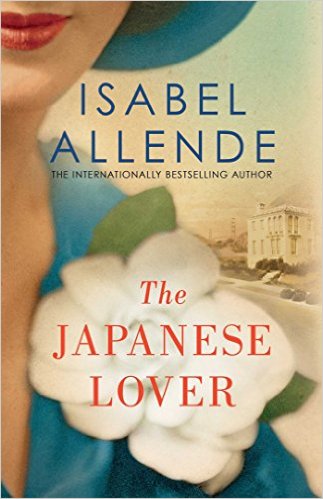
The Japanese Lover - Isabel Allende


Simon & Schuster, Nov. 3, 2015.


Five Stars


Isabel Allende has been one of my favourite authors for a long time. Recently I have read two of her novels that I did not enjoy at all (Ripper and The Infinite Plan), which was so disappointing. They were average novels, good in their own way, just not up to par with my expectation of Allende. In her newest novel, The Japanese Lover, she goes back to her earlier work in both style and subject – it is large in scope and yet it describes an intricate love story. Overall, I was very impressed, and happy to see the return of the wonderful Isabel Allende.


In The Japanese Lover, Allende’s characters travel seamlessly from the past to the present and back again, in the world of memory. The flashbacks are never out of place and the plot has a natural flow. Alma, living a quiet life in a retirement home, has divested herself of all unnecessary belongings, and lives only to reflect back on her former love. She tells her story to her grandson Seth and her assistant, Irina, who has her own hidden past. Through Alma’s memories, we learn about Ichimei, the Japanese boy that stole her heart during childhood before disappearing into an internment camp during World War II. Alma and Ichimei are never truly separated, however, and he continues to write to her throughout their long lives. As he says in one of his final letters, “we have loved each other in past lives and will go on meeting in lives to come.” (p. 322)


Allende explores the hypocrisy of the many Japanese-Americans who were segregated into camps during WWII and yet still joined the U.S. Military and fought for the freedoms of their fellow Americans. Ichimei’s father left Japan because he did not want to participate in their militarized culture, yet his son, Ichimei’s brother, chooses to fight for a country that would imprison his family simply for having a Japanese heritage.


Throughout the novel, Alma is often used as a way to look back at the past and the tragedy of Japanese internment. Without the secondary plot line of Irina, Alma might be no more than a tenuous link to the past. Her interactions with Irina and Seth strengthen her voice and her ability to reflect back with brutal honesty on the choices she has made in the past. With the addition of Irina and the other characters at the retirement home, there is room for many issues to be explored in the novel. Sometimes it was distracting, but for the most part the ideas strengthened each other with their connections – ultimately, there are many different kinds of casualties of war.


I found the language of the novel to be very simple and straightforward, although this may be due to the translation. No matter how intimate the subject, the tone is always slightly detached, and removed from emotion – it gives the writing an otherworldly feel that I remember from Allende’s earlier novels. There is a distance from the characters, and it was a struggle to get to the heart of the story, but it was worth it in the end. I was kind of disappointed not to see just a little bit of the magic realism that featured in Allende’s novels such as The House of the Spirits. This was more like realism with just a hint of magic – for instance, when Ichimei is apart from Alma, “[h]is flowers grew more colorful and perfumed than ever to console him.” (p. 243)


Overall, I appreciated that the love story was so realistic. The novel confronts us with the fact that sometimes we have to accept reality – love doesn’t always conquer all. At the same time, a place for love can be carved out in unexpected places, and that is the hidden place where Alma could be with Ichimei. Alma shows us a realistic experience of growing old, and with a strong voice, she calmly reflects on her past and sets an example for Seth and Irina, who have their own challenges to overcome. As Alma’s life winds down, there is hope for the happiness of a new generation.


I received this novel from Simon & Schuster in exchange for an honest review.